


Anti-stress harness STURMFREI® Saver for large dogs

- Lieferzeit: 2-5 Werktage
- Low stock - 2 items left
Does your dog pull, bark, freak out on the leash , or refuse to go for walks altogether?
Experience a new kind of dog walk. Remove triggers that increase his excitement and guide him back to you as soon as the leash becomes taut.
Lead the dog from the front , instead of punishing him with neck jerks or encouraging him to chase by leading him from behind. Watch how your dog walks more calmly and upright on the leash.
The pressure onto the shoulder when the leash is tensioned provokes a distraction and enables the The dog should be directed towards where its attention is desired. This can de-escalate dog encounters. and be interrupted. Say something like "grapefruit" when you turn your dog towards you and he comes towards you. This will make it easy to recall him, even when he's off-leash or on a long leash. through the expression "grapefruit" (Choose a phrase that differs from the usual words the dog hears).
Our anti-pulling harness STURMFREI® Saver is a new version of our STURMFREI®, which is supplemented by a second belly strap and offers a more secure hold in case of an escape reaction.
The black (L) version comes in a leash set with a blue (instead of a black) leash.
The lead from the front:
- Corresponds to biologically programmed stimulus-response chains for stopping or steering (communication via the front area)
- Allow the dog to continue to remain upright while walking , instead of stiffening up.
- Reduces the risk of Leash aggression and biting
- When tightening the leash, gently brake the dog at the shoulder and does not convey a feeling of strong threat (collar)
- Allows stress-free interruption of dog encounters by turning away
- Does not trigger the chase (chest harnesses/pulling harnesses) and does not narrow the dog's field of vision - The dog is responsive.
- Can have a positive effect on health (fewer stress symptoms due to reduced tension on the leash when tightened)
- Supports the socialization of the dog and the development of a healthy dog personality with social skills towards other dogs
STURMFREI® is fundamentally designed to gradually reintroduce the dog to its environment through intuitive guidance and avoidance of stress amplification caused by the opposition reflex .
Determine the correct size based on the Size chart .
Sturmfrei® is protected by the EU trademark EUTM 013790241 registered with the European Union Intellectual Property Office (EUIPO) and by the European patent EP 3 209 120
Find the right size for your dog by measuring him. 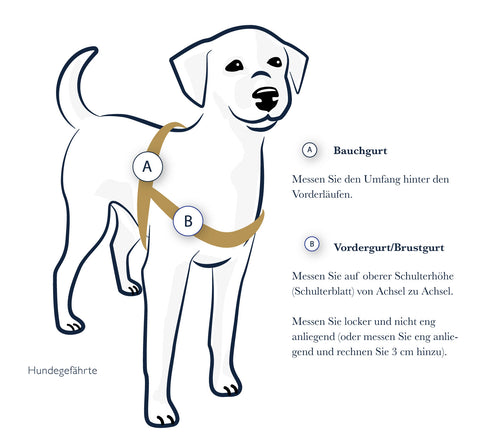
Here you can find detailed instructions for measuring .
Materialprofil
POP-Band ist ein gewebtes Material (ca. 1,5 mm dick) und insgesamt weicher sowie flexibler als BioThane®. Dadurch liegt es angenehm am Hund an und eignet sich besonders für Situationen, in denen ein etwas weicheres Material gewünscht ist.
BioThane® ist ein kunststoffummanteltes Gurtband im Lederlook. Es gilt als extrem reißfest, langlebig und ist besonders pflegeleicht (schmutz- und wasserabweisend). BioThane® wurde ursprünglich für hohe Belastungen entwickelt und ist deshalb sehr robust im Alltag.
BioThane® Dicke:
X-Trem: 1,5 mm
Power: 2,5 mm (nur für sehr robuste Hunde geeignet)
Was sagt die Materialbreite beim Hundegeschirr aus?
Die Materialbreite beeinflusst die Wahrnehmung in der Vorderführung: Je breiter das Material, desto deutlicher ist das Feedback für den Hund, sobald Leinenzug entsteht. Manche Hunde reagieren bereits auf die leichte Berührung im Schulterbereich. Andere (vor allem hochreaktive Hunde) brauchen in den ersten Trainingswochen eine klarere Reiz-Reaktions-Rückmeldung, um sich sicher umlenken zu lassen.
Edition 2026
Fein optimiert – Premium-Details für ruhige Führung im Alltag.

Kurzprofil
Farben: Es sind nur die in der Auswahl angegebenen Farben & Kombinationen verfügbar.
Längen der Gurte
M
Vordergurt: 39 – 47,9 cm
Bauchgurte: 60 – 84 cm
L
Vordergurt: 45 – 52,9 cm
Bauchgurte: 60 – 84 cm
XL
Vordergurt: 52-57,9 cm
Bauchgurte: 80 – 100 cm
XXL
Vordergurt: 57-63,9 cm
Bauchgurte: 80 – 110 cm
XXXL
Vordergurt: 63-70,9 cm
Bauchgurte: 90 – 130 cm
Hundeleinen
Drei Leinen – drei Szenarien. So haben Sie immer die passende Führung in der Hand.
RATZFATZ
Die variable Allround-Leine: schnell umstellen, sauber führen, kontrolliert bleiben.
Kurzprofil
Empfehlung
UM’S ECK
Die Kurzleine für Wege, Stadt, Training: minimalistisch – aber maximal souverän.
Kurzprofil
Empfehlung
CHILL
Das flexible Setup: Einklicken, umhängen, Handgriff bilden – ideal im Alltag.
Kurzprofil
Handling
Weitere Bestandteile
- Bruchsicheres Edelstahl
- Edelstahlschrauben
- Edelstahlkarabiner
- Hochwertige Schließer (bruchsicher bis -20 Grad)
- Sicherheitsnähte
- Vordergurt hitze versiegelt
- Vernickelte oder verchromte Leinenkarabiner
- D-Ringe aus Edelstahl
Hinterer Bauchgurt und unteres Verbindungselement der Variante STURMFREI® Saver sind abnehmbar.
Bitte beachten Sie unsere Hinweise zum 14-tägigen Widerrufsrecht .
What are POP-Band and BioThane®?
POP tape is a woven material, approximately 1.5 mm thick , and generally softer and more flexible than BioThane®. BioThane®, on the other hand, is extremely tear-resistant , durable, and particularly easy to clean .
What does the material width mean for tableware?
The width of the material affects the effect of the leash: the wider the material, the more resistance your dog will feel when pulling. Some dogs respond to even a light touch on the shoulder when the leash is tightened. Others (especially highly reactive dogs ) need more pressure in the first few weeks of training to reliably redirect their gait.
Can my dog free itself from the STURMFREI® harness?
There is never a 100% guarantee that a dog cannot escape from a harness – this applies to all dog harnesses . If you are concerned that your dog might slip out, please consider the following points:
- Adjust the front strap over your shoulders .
- Adjust the front strap to be a little tighter .
- Use an additional safety measure (e.g., collar + loose second leash).
Generally, most dogs become more relaxed and cooperative immediately when using STURMFREI®. Important: Training is crucial , especially for dogs that pull strongly or are highly reactive. The more consistently you practice in the first few weeks, the faster your dog's behavior will change.
Can my dog chew through the harness?
Yes. Theoretically, a dog can chew through any material that can be cut. Only metal is inedible. Therefore, please do not leave your dog unattended while chewing on its harness.
Does the tableware show any signs of wear after use?
Yes – like any high-quality product, STURMFREI® will show signs of wear over time. This depends on factors such as stress , friction , sweat composition, dirt, and individual usage. Important: The tableware remains fully functional , even if it no longer looks brand new.
Can I jog or cycle while wearing the dishes?
Yes – however, please practice the routine first in a calm environment and ensure the harness is correctly adjusted. Pulling ("rushing forward") can intensify significantly with rapid movement. Therefore, proceed slowly and increase the speed and intensity of the stimulus step by step.
Can I use the STURMFREI® harness with longer leashes?
Yes. There's an additional carabiner on the back: Thread the leash through it and then attach the leash carabiner at the front. Please note: Due to the altered angle of pull, it may be advisable to start training with a short leash for dogs that pull strongly.
Recommendation: Initially, practice by "shifting" your dog from right to left when the leash tightens. This will sensitize your dog to slow down and focus on you.
The reviews are "too good" – how can that be?
The reviews come from customers who are thrilled because their dogs often respond immediately to the lead . With highly reactive dogs , this isn't always apparent on the first walk – the environment , stress level , and training routine play a significant role.
In approximately 80% of cases , however, an immediate improvement is noticeable or the problem is solved immediately (depending on the dog and the situation).
Does the STURMFREI® harness hinder your dog's walking?
No – not if adjusted correctly. Adjust the front strap loosely or quite high (above the shoulders) . A restriction should only occur when the leash tightens.
Tip: You can enhance the effect by supporting the redirection with a slight horizontal twisting motion . This will automatically orient your dog towards you and prevent him from pulling, so he doesn't get led away from the object of his interest. You can find out exactly how the training works and why it's effective in the member portal (you'll receive the link in your shipping confirmation) .
What are the long-term effects of front-end steering?
Your dog will become calmer – even during encounters on the leash. Most importantly, its upright posture remains unchanged: STURMFREI® dogs continue to walk upright and relaxed even in old age , as they are not subject to the tension caused by leash tightening that collars and harnesses trigger. Leash encounters with the STURMFREI® are no longer a problem at all (your dog is relaxed, and you can simply turn around if necessary).
When should I start with the front-end presentation?
The earlier the better. Dogs – like humans – learn particularly quickly through so-called stimulus-response chains :
"If A happens, I'll do B."
Starting early prevents unwanted routines from becoming ingrained in the first place, e.g.:
-
frantic panting when the leash is pulled
-
Jumping up / barking / rearing up
-
aggressive behavior in encounters
-
Pulling hard or pushing downwards
The ideal time to start is after your dog has had a chance to burn off energy outdoors , when they are already physically active. This makes it much easier for them to stay calm and learn.
Leash tightens → I orient myself towards my owner.
Over time, this develops into a new habit:
Your dog avoids pulling on the leash because he prefers to keep his eye on what interests him – instead of constantly being distracted.
Who invented the front-wheel drive?
The original concept of front-line training was developed by an American woman who wanted to create a training method that was as gentle as possible and logical for the dog. Front-line training is very popular in the USA.
Erfahren Sie, wie Sie Ware umtauschen oder zurücksenden können.
- Hilft bei stark ziehenden Hunden – reduziert Zug durch Umlenkung im Brustbereich.
- Besonders geeignet für kleine Menschen mit kräftigen Hunden – der Hund lässt sich leichter kontrollieren.
- Ideal bei Leinenaufregung und Hundebegegnungen – der Hund kann aus der Vorwärtslinie genommen werden.
Erhalten Sie 15% Rabatt mit einer Newsletter-Eintragung.


